

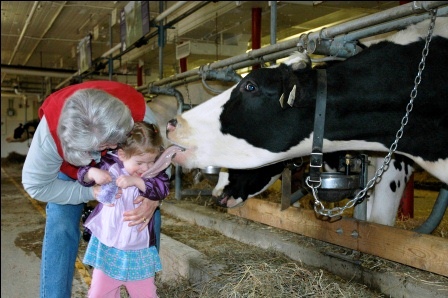
 Those of us living in the country and in contact with farms and farm animals are being blessed with an immune priming experience for free – other than the cost of washing the clothes!
The exposure to bacteria, fungi and other microbes confers to us a unique advantage in the reduction of asthma and atopy incidence compared to children who never have farmyard contact and has previously been reported as such.[1]
I can see some innovative farmers seeking to promote a day out at their farms as an immune priming experience in the future a sort of ‘Farm Yard Atopy Camp’ for all children under 5 with a guaranteed cowlick experience!
A dirty weekend away will start to lose its cachet amongst the older family members and represent a weekend of juvenile delights in which washing behind the ears will be postponed for a little while.
The article in the New England Journal of Medicine looked at two large cross sectional studies exploring the incidence of asthma and atopy in more than 16,500 school children.[2]
The two studies — dubbed PARSIFAL and GABRIELA — replicated previous research showing that the incidence of asthma and atopy is lower among children raised on a family farm.
Specifically, compared with children who did not live on a farm:
- Odds ratios for allergy were 0.49 in PARSIFAL and 0.76 in GABRIELA and both were significant at P<0.001.
- Odds ratios for atopy were 0.24 in PARSIFAL and 0.51 in GABRIELA, and again both were significant at P<0.001.
Both studies investigated indoor dust exposure for a randomly selected subset of the children, using different methods.
In PARSIFAL, the investigators used single-strand conformation polymorphism analyses, in which known microbes produce recognizable bands on a gel. In GABRIELA, they employed traditional culture techniques.
Analysis showed that diversity of exposure was inversely related to the risk of asthma. Indeed, they found, for every additional 10 bands seen in the PARSIFAL study, the risk of asthma fell by 38% (OR 0.62, 95% CI 0.44 to 0.89).
Similarly, for each increase of one taxon in GABRIELA, the risk of asthma fell by 14% (OR 0.86, 95% CI 0.75 to 0.99).
On the other hand, microbial diversity had no significant impact on the risk of atopy, they reported.
Comment
One possibility is that some combination of microbes stimulates the innate immune system and prevents it from entering a pro-asthma state.
It is also possible that exposure to many different microbes makes it harder for those that can induce asthma to become dominant in the lower respiratory tract.
References
[1] Gern JE “Barnyard microbes and childhood asthma” N Engl J Med 2011; 364: 769-770. View Abstract
[2] Ege MJ, et al “Exposure to environmental microorganisms and childhood asthma” N Engl J Med 2011; 364: 701-709. View Abstract