

 There seems no end to the illnesses this secasteroid is capable of influencing, although it should be of no real surprise that Vit D deficiency is linked to the respiratory condition asthma. The reason….mucosal tissues such as those found in the lung are rich with immune receptors that are intimately tied into the Vit D receptor family. Vitamin D up regulates a specific gene that produces over 200 anti-microbial peptides, some of which work like a broad-spectrum antibiotic.
Because of its beneficial role in respiratory tract infections and immune system modulation, it has been hypothesised that vitamin D status might affect the risks for exacerbations.[1] This paper shows show that children with initial circulating vitamin D levels of 30 ng/mL or less (vitamin D insufficiency) have a 50% greater risk for severe exacerbation over the course of a 4-year clinical trial of asthma treatment than children with circulating vitamin D levels of 30 ng/mL or greater (vitamin D sufficiency) at the start of the trial.
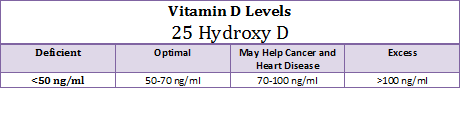
There remains considerable variation in the perceived optimal levels for Vitamin D with many researchers favouring 50ng/ml as the base line a considerable increase on the levels reported here. An approximate guide-line for health care providers who choose to measure serum 25-hydroxyvitamin D in their patients would to aim for 40-60 ng/mL, unless there are specific contraindications.
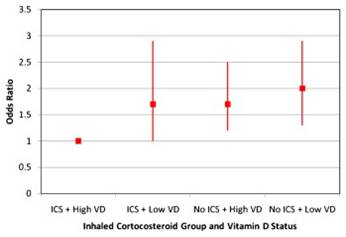
The authors also investigated the joint effects of vitamin D status and randomisation to inhaled corticosteroids (ICSs; see Figure). They found that compared with children who were randomised to ICSs and who had vitamin D sufficiency at the start of the trial, children who either:
- had vitamin D insufficiency but were randomised to ICSs or
- had vitamin D sufficiency but were not receiving ICSs
…had 70% increased risks for severe exacerbations.
- children who had vitamin D sufficiency and who were not receiving ICSs
…had the highest risks for exacerbations.
The authors conclude that sufficient vitamin D status decreases the risk for asthma exacerbations and might potentiate the beneficial effects of corticosteroids. However, a previous paper demonstrated an inverse relationship between mother’s intake of vitamin D during pregnancy and incidence of asthma in early childhood.[2] The authors concluded
In these children, lower vitamin D levels are associated with increased markers of allergy and asthma severity.
Suggesting that steroid enhanced benefits may not be the mechanism behind the immune benefit butrather that the relevant genes are being activated to reduce exposure and limit responsiveness.
Comment
The role of Vitamin D in health management is compelling and yet the fear of risk from excess VitD has meant many practitioners have been hyper cautious about the daily dose recommendations. There are two components to risk management to be considered. The first is to take a base line 25(OH)D test at the start of supplementation and dose accordingly, following up with a second test a few months later. The second is to consider the evidence of inadvertent risk creation. The consumption of experimental supplementation of 5,000 – 10,000 iu/d in health adults for 4-5 months have not:
- Elevated serum Ca
- Elevated urine Ca
Further these doses reproduce 25(OH)D levels frequently found at the end of the summer in outdoor workers – at which level no hyperabsorption occurs.[3]
References
[1] Brehm JM, Schuemann B, Fuhlbrigge AL, Hollis BW, Strunk RC, Zeiger RS, Weiss ST, Litonjua AA; Childhood Asthma Management Program Research Group. Serum vitamin D levels and severe asthma exacerbations in the Childhood Asthma Management Program study. J Allergy Clin Immunol. 2010 Jun 8 View Abstract
[2] Brehm JM, Celedón JC, Soto-Quiros ME, Avila L, Hunninghake GM, Forno E, Laskey D, Sylvia JS, Hollis BW, Weiss ST, Litonjua AA. Serum vitamin D levels and markers of severity of childhood asthma in Costa Rica. Am J Respir Crit Care Med. 2009 May 1;179(9):765-71 View Full Text
[3] Hathcock JN, Shao A, Vieth R, Heaney R. Risk assessment for vitamin D. Am J Clin Nutr. 2007 Jan;85(1):6-18. Review. View Full Paper