
Chronic Fatigue and the Mysterious XMRV Link
Everyone who suffers with this condition and the many thousands of practitioners involved in their health recovery are interested in whether there may be a causal agent identifiable through appropriate tests – not that there is a treatment on offer, but more a case of validation I suspect. This topic has attracted a great deal of attention in the orthodox and alternative medicine world and has some time to go before the explanations become viable treatments. Keeping up to speed with the science will assist all practitioners in their potential application.
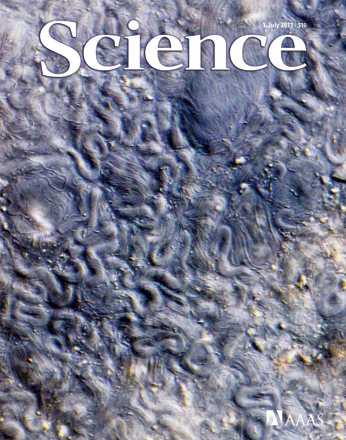
The debate over XMRV began back in 2009 when researchers led by Judy Mikovits of the Whittemore Peterson Institute (WPI) for Neuro-Immune Disease in Reno, Nevada, reported in Science: traces of the virus in peripheral blood mononuclear cells, a type of white blood cell, of 67% of CFS patients. By contrast, only 3.4% of healthy controls were found to harbour the virus. The team also showed that XMRV could infect human cells and concluded that the virus—which had previously been linked to prostate cancer—might play a role in causing CFS.
Read the rest of this page »
Enjoyed this article?
How Can We Cure NO/ONOO− Cycle Diseases? A Review
Approaches to Curing Chronic Fatigue Syndrome/Myalgic Encephalomyelitis, Fibromyalgia, Multiple Chemical Sensitivity, Gulf War Syndrome and Possibly Many Others by Martin L. Pall, PhD
From the Townsend Letter
February / March 2010
Abstract
The NO/ONOO− cycle is a biochemical vicious cycle that is thought to cause such diseases as chronic fatigue syndrome/myalgic encephalomyelitis (CFS/ME), multiple chemical sensitivity (MCS), fibromyalgia (FM), and possibly a large number of other chronic inflammatory diseases. The chemistry/biochemistry of the cycle predicts that the primary mechanism is local such the depending on where it is localized in the body, it may cause a variety of different diseases. Previous studies have shown that agents that lower such cycle elements as oxidative stress, nitric oxide, inflammatory responses, mitochondrial dysfunction, tetrahydrobiopterin (BH4) depletion and NMDA activity produce clinical improvements in CFS/ME and FM patients, consistent with the predictions of the cycle mechanism. Multiagent protocols lowering several aspects of the cycle appear to be the most promising approaches to therapy. These include an entirely over-the-counter nutritional support protocol developed by the author in conjunction with the Allergy Research Group. However, such
Read the rest of this page »