Vitamin K: Beyond Clotting
Q & A with Sarah L. Booth, PhD
Senior Scientist and Director, Vitamin K Lab, Tufts University
Vitamin K is one of those nutrients that has lost its position as a vital component of nutritional therapy as it was thought that so little was required. But along with vitamin A this nutrient, due to more sophisticated investigation options is now getting some well deserved respect and it is becoming clear that it impacts on many aspects of health – maybe this will gain as much respect as Vitamin D in the coming years.[1],[2]
Focus: So, let’s talk about vitamin K. Why don’t we hear more about this fat soluble vitamin?
SB: The vitamin K research community is extremely small, and we don’t have the volume of publications that the other fat soluble nutrients have. We’re probably decades behind in research findings. Vitamin K was identified for its role in blood clotting but we need very little for blood clotting. The body seems to be exquisite at taking what it needs to support clotting, and we don’t have a public health problem associated with abnormal bleeding. Our current dietary recommendations for vitamin K are based on the amount that’s ideal for clotting—90 micrograms a day for women and 120 micrograms a day for men.
Read the rest of this page »
Update on Vitamin D Benefits for – Psoriasis and Preeclampsia
Psoriasis.
Psoriasis is a lifelong inflammatory skin disease characterised by sharply demarcated, scaly, erythematous plaques. Effector cells of the innate immune system, such as keratinocytes, have been shown to have a role in the pathogenesis of psoriasis.
The current view of psoriasis pathogenesis proposes that a combination of environmental and genetic factors confers susceptibility to the disease and that a dysregulated immune response leads to a series of linked cellular changes in the skin.[1]
Read the rest of this page »
The Virtue of Modesty: How Regular, Modest Doses of Sun and Vitamin D Are Key to Longterm Health
Read the rest of this page »
Krispin Sullivan is a licensed clinical nutritionist and educator, and author of Naked at Noon: Understanding the Importance of Sunlight and Vitamin D. She received her degree in dietetics at the University of Vermont in 1968, and her certification in nutrition from the National Institute of Nutrition Education in 1988. She is former director of the nutrition program for Northern California Recovery Systems in Mill Valley, California, and is licensed by the state of California to teach nutrition in post-secondary schools. She currently resides in Incline Village, Nevada, and is studying the microbiome in humans, and writing a book on microbial gut inhabitants as a protective shield.
Her website is http://www.krispin.com
Increase Vit D RDA’s Say Scientists
On July the 28th 2010 the Journal Experimental Biology and Medicine published an article looking at the levels of Vitamin D in the general population and made recommendations concerning the RDA levels needed to limit osteomalacia in adults and rickets in children.[1] This they say is because scientists and nutritionists from many countries agree that at present about half of elderly North Americans and Western Europeans and probably also of the rest of the world are not receiving enough vitamin D to maintain healthy bone. This is nothing new to this web site or indeed the thousands of people that have been following this story for the last 10 years.
The paper goes on to say that over the past decade there has been a dramatic increase in the understanding of the many biological actions that result from vitamin D acting through its daughter steroid hormone, 1α,25-dihydroxyvitamin D3 [1α,25(OH)2D3] in collaboration with its cognate vitamin D receptor (VDR). In other words Vitamin D does more than support bone health.
Read the rest of this page »
Vitamin A: The Key to A Tolerant Immune System?
By Michael Ash, BSc(Hons). DO. ND. FellowDipION
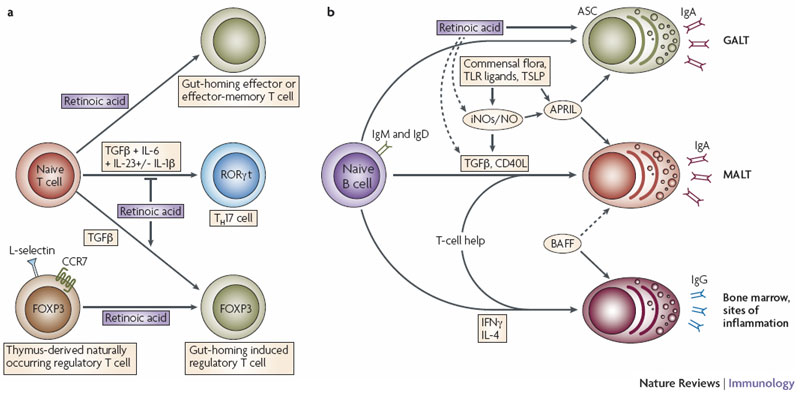
Vitamin D and Vitamin A are essential co-partners in immunological and bone health.[1],[2] I’m particularly excited about vitamin A because of its profound effects on the gut mucosal immune system—a specialty of mine. Just as vitamin D has attracted attention for its ability to increase antimicrobial peptides and help us defeat pathogens, it’s fascinating to me that vitamin A is also essential for the very tissues that protect us from the same pathogens.
The availability of vitamin A in our food is a key factor in a tolerant, highly functional immune system. To quote from the title of a brilliant commentary in the March 2008 issue of Nature’s Mucosal Immunology, “Vitamin A rewrites the ABCs of oral tolerance.”[3]
Vitamin A is crucial to a very sophisticated bi-directional mechanism that takes place in the digestive system and leads to immune tolerance across the entire gut lining. Immune tolerance is the essence of good health. An intolerant immune system will lead to a wide range of illnesses, and the gut is where many people first lose immune tolerance. Vitamin A (retinoic acid) is key to our ability to consume a wide range of antigens (food) and yet not react adversely, and it’s quite fascinating.
Read the rest of this page »
Do Diets Leave You Micronutrient Deficient?
The shortage of essential micronutrients in the human diet has been linked to multiple health and disease related problems. Dr Bruce Ames has described how the micronutrient triage theory can account for disease induction and more rapid levels of poor quality aging. I have written about the expensive urine myth and how the failure to recognise the differing demands placed by cells at different times can lead to altered and compromised health function.
This paper looks at the nutritional intake of people following a weight loss diet.[1] Based on the USA figures, the authors say that about 1/3 of the population are following some sort of weight loss orientated nutritional programme. The study looked to see if 27 micronutrients could be ingested in sufficient quantities whilst following 4 well known diets to meet minimum RDA levels as determined by the USA regulatory body the FDA.
Read the rest of this page »
When Should I Take Vitamin D?
The question is often asked – when should I take my supplements. Most of the time, this is down to a matter of convenience as much as it is to absorption and nutrient availability. However this is a very valid question in terms of Vitamin D consumption. Vit D levels have attracted lots of attention over the last few years and included with this has been a number of trials and clinical experiences in which there have been differing levels of success based on supplementation in terms of increased blood levels. This paper out in February 2010 in the Journal of Bone Metabolism[1] helps to explain these anomalies.
Many patients treated for vitamin D deficiency fail to achieve an adequate serum level of 25-hydroxyvitamin D [25(OH)D] despite high doses of ergo- or cholecalciferol.
Atishoo – that’s D’ one!
Vitamin D Vs Influenza A
Lets face it, right now we are still recovering from the various revelations about the novel variant H1N1 or swine flu non event (in terms of pandemic effects) to be looking to see if we can manage the more common seasonal influenza. Plus spring is in the air and we all know that colds and the flu viruses seem to be less vigorous during the time of the year we actually see the sun!
However a rather neat randomised trial to see if Vitamin D supplementation had any prevention effect in school children adds further weight to the evolving understanding of its innate immune activation potential.[1]
Read the rest of this page »
Could a ‘Bacterial Thali’ Resolve Inflammation? – A Novel Strategy
Michael Ash BSc(Hons) DO, ND, DipION reviews the possibility that strategically selected foods and food concentrates represent a valid therapy for inflammatory illnesses.
There is substantive interest in the potential translation from bench to bedside of simple safe strategies to modify the adverse effects of inflammation. Approaching from a preventative and restorative angle the numbers of papers being published on the role of orally ingested bacteria (probiotics) and in this article – the herb Tumeric (active ingredient of which is curcumin) is presenting increasingly supportive evidence for their reasonable and safe clinical use.
Modern analytical techniques are helping to reveal novel opportunities for inflammation control in the gut and the systemic tissues in new ways that even a few years ago would have been thought of as very alternative!
Read the rest of this page »
Lifestyle Changes Better Than Drugs for Diabetes Prevention
A series of papers out in the New England Journal of medicine on March the 14th 2010 have failed to add any substantive weight to the use of medication in the prevention of diabetes and cardiovascular disease. [1],[2],[3]
The continued expansion of the western global waistline and incidence of diabetes has provided fertile opportunity for a wide range of clinical trials designed to uncover strategies for incidence of diabetes reduction.[4] There is no surprise in the discovery that making significant changes to people’s lifestyles, eating less and being more active, the primary causes of weight gain, also have a consistent reduction in type II diabetes risk. The real success has also been in the associated benefits in reduction of related cardiovascular disease risk[5] and raising of mood.[6]
Read the rest of this page »


The immune system is prone to the same grave misfortunes as any defense system handling weapons: collateral damage that comes with the destruction of the enemy on one’s own territory and friendly fire due to mistaken identity. Whereas the collateral damage is the price we pay for clearance of infections, autoimmunity is a pathological process. Nevertheless, the effector mechanisms involved in both processes are the same. Whether environment can be a cause, a trigger or an amplifier of an autoimmune disease are questions that are being intensively investigated.